

Text size:
Costa Sul PR05SMA
How to get there
Leaving from the Cais da Vila (pier), follow the signs towards Vila do Porto, coursing the main road. After about 930 metres you will find the Matriz da Vila do Porto church on your right, go straight ahead about 120 metres and on the Rua Teófilo Braga (street), the House of Fossils/ Dalberto Pombo Environmental Interpretation Centre is on your left.
Recommended gear
Appropriate footwear for walking, waterproof jacket, hat, sunscreen and water.
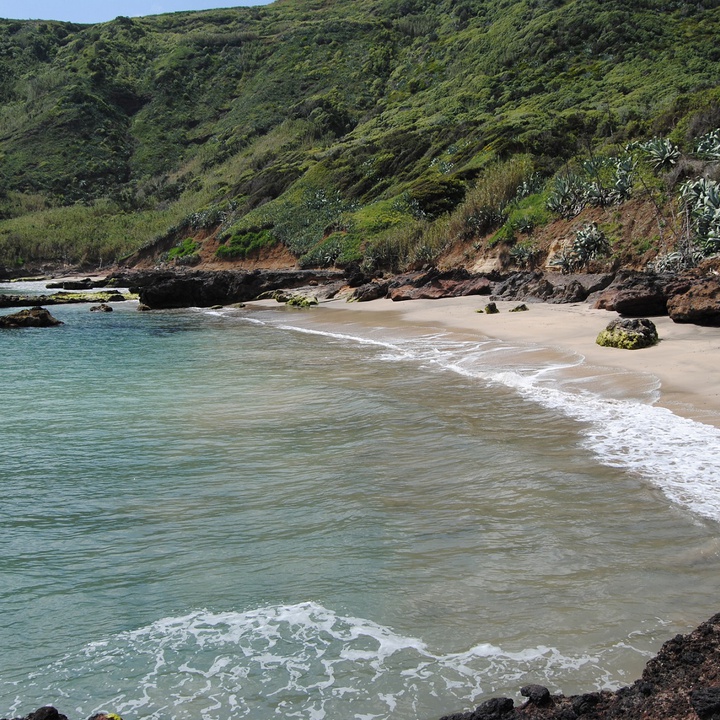

This route connects Vila do Porto to Praia Formosa, in the parish of Almagreira, the venue for the Maré de Agosto festival, the country’s oldest music festival.
The route combines historical heritage, geological richness and the unique coastal landscapes of the island of Santa Maria, passing through the entire Pedreira do Campo, Figueiral and Prainha Natural Monument and ending at Praia Formosa.
The trail begins next to the Fort of São Brás, a 17th-century military structure overlooking Calhau da Roupa Bay and the commercial port. From here, the path descends to Ribeira de São Francisco, one of the best spots on the island for observing migratory birds, particularly in autumn and winter. Among the species frequently seen along the stream are the Grey Heron (Ardea cinerea), the Little Egret (Egretta garzetta), the Coot (Fulica atra) and the Whimbrel (Numenius arquata). Shortly afterwards, the trail reaches Pedreira do Campo, a geosite classified as a Natural Monument, where pillow lava formations and sedimentary rocks rich in marine fossils can be seen — evidence of the ancient submerged landscape that once characterised this Region. The route follows the south coast to the Gruta do Figueiral, an artificial cave where, for centuries, clay and limestone were extracted for the production of roof tiles and lime used in the island’s traditional architecture. On the walls and ceilings of the cave, and even in the bricks of the old kiln that once stood there, it is still possible to spot various fossils of marine bivalves. The climb to Touril takes walkers through areas where various resident bird species can be spotted, such as the Common Buzzard (Buteo buteo rothschildi), the Rock Dove (Columba livia atlantis), and the endemic Santa Maria Goldcrest (Regulus regulus sanctaemariae). Following the signposts, the trail then enters a woodland on the right, descending to Prainha. On days of rough seas, it is recommended to use the alternative route indicated. From Prainha, the trail continues along the coast — a section that requires caution due to its exposure and steep gradient, but is equipped with a steel cable to aid crossing. The route continues past the ruins of São João Baptista Fort and reaches a junction connecting to Cardal via the GR 01 SMA – Grande Rota de Santa Maria. Finally, the trail ends at the Praia Formosa car park, unique in the Azores for its golden limestone sand, formed by the erosion of the island’s sedimentary formations. Here, visitors are invited to rest, take a dip in the sea, and, if they wish, continue their walk along the PR06 SMA – Areia Branca, which starts from the same area.