

Text size:
News
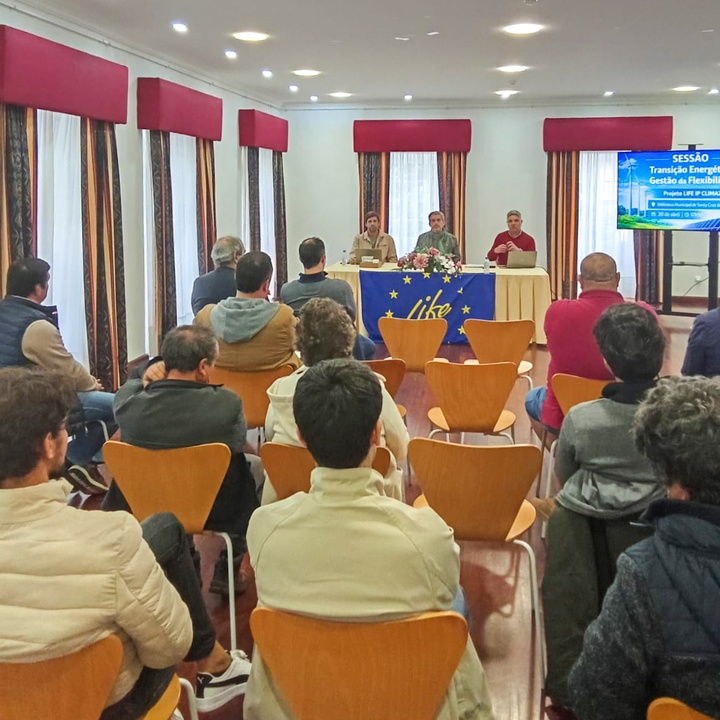
LIFE IP CLIMAZ hosts session on Energy Transition and Flexibility Management on Graciosa island
July 7, 2026
On April 20, an informational session dedicated to Energy Transition and Flexibility Management was held at the Santa Cruz da Graciosa Municipal Library as part of the LIFE IP CLIMAZ project, coordinated by the Regional Secretariat for the Environment and Climate Action. The event was attended by 25 people and was organised by the Regional Energy Directorate (DREn) and EDA, S.A., associate beneficiaries of the project, in collaboration with UNINOVA, the entity responsible for developing the technology associated with the e-Flexi project.
The session brought together entities from the island of Graciosa and participants involved in the pilot project, with the main objective of discussing the challenges and opportunities of the energy transition in island contexts, with a special focus on energy flexibility management and the objectives of the e-Flexi project.
During the session, strategic issues for the Region were also addressed, namely the Regional Energy Strategy and the challenges associated with integrating renewable energy sources into island power systems. The role of energy flexibility as an essential factor in improving power system efficiency and reducing dependence on fossil fuels was also highlighted.
The session also provided an opportunity to present the installation phase of the Minimum Viable Product (MVP), consisting of ten units to be installed in the homes of participants in the pilot project on the island of Graciosa. With the planning phase now complete—which included preparatory work and initial development activities—a smart management system for the electric storage water heaters already installed in the participating homes will now be put into operation.
This system, developed by EDA in partnership with UNINOVA, integrates equipment and artificial intelligence algorithms to enable dynamic charging of storage heaters based on the availability of renewable energy, particularly during periods when grid injection is curtailed.
The main objectives of this solution are to characterise the daily energy flexibility needs of the island’s electricity system, optimise the activation of flexible equipment—such as controllable water heaters—and contribute to achieving the goals defined by EDA’s asset operation strategy, specifically the reduction of curtailment periods. To this end, a Flexible Asset Management Platform will be used to manage, in real time, a set of devices for the heating and storage of domestic hot water (DHW), enabling more efficient use of available energy.
In practical terms, the goal is to reduce renewable energy waste, minimise reliance on the thermal power plant during periods of low demand, and increase the overall efficiency of the electrical system.
To launch the pilot project on the island of Graciosa, EDA has selected 10 homes and plans to gradually expand the solution to include approximately 1,400 units across the islands of Graciosa, Flores, and São Miguel. This is an innovative measure with high potential for replication on other islands and significant energy and environmental benefits, even with a relatively small investment, especially in systems with high renewable energy penetration.
The session concluded with a Q&A session and an exchange of perspectives among the participants, reinforcing the role of LIFE IP CLIMAZ as a flagship project for the energy transition and adaptation to climate change in the Autonomous Region of the Azores.
With the financial support of the LIFE Programme of the European Union.