

Text size:
News
Regional Government marks International Day for Biological Diversity with awareness-raising and environmental education initiatives
May 22, 2026
The Regional Secretariat for the Environment and Climate Action marked today the International Day for Biological Diversity, established by the United Nations with the aim of raising public awareness of the importance of preserving biodiversity and the growing challenges to its conservation.
The 2026 celebration of the occasion was held under the theme “Local action, global impact,” emphasising that every environmental protection gesture can make a decisive contribution to building a more sustainable and balanced future.
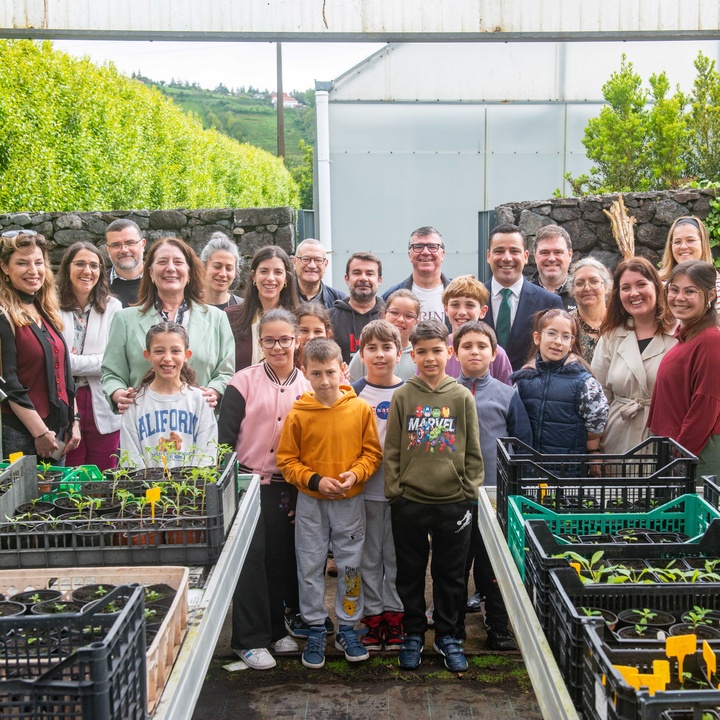
The Regional Secretary for the Environment and Climate Action, Alonso Miguel, took part in the celebrations with a visit to the Faial Botanic Garden Nurseries. He was accompanied by the Regional Director for the Environment and Climate Action, Ana Rodrigues, as well by 3rd and 4th students from Castelo Branco Elementary School.
On the occasion, the government official explained that “this date is of particular significance for the Azores, given the archipelago’s unparalleled natural wealth, characterised by the existence of unique ecosystems and a high number of endemic species, which represent a natural heritage of exceptional value.”
“The unique biodiversity of the Azores represents an extremely valuable heritage, but one that is also very fragile and sensitive, so it is up to all of us, working together, to ensure its preservation,” he said.
Alonso Miguel emphasised that “biodiversity plays a key role in the balance of ecosystems and in quality of life of the population, providing fundamental ecosystem services that ensure air quality, the health of our soils, the quality of our food, the recharge of aquifers and the availability and purification of our water resources.” This ultimately “contributes to the safety and well-being of communities by reducing the risks associated with various natural hazards, such as floods, landslides, droughts or fires.”
Therefore, the Regional Secretary acknowledged that “the preservation of biodiversity and the sustainable management of our resources must be regarded as a priority mission from the standpoint of government action at various levels. This necessarily requires the involvement of society as whole and a firm and ongoing commitment to environmental literacy.”
In this context, the Regional Secretariat for the Environment and Climate Action has been strengthening its efforts through very significant investments in the implementation of various nature conservation and biodiversity preservation programmes. It relies, for this purpose, on strategic financial and operational instruments available to the Region, namely the LIFE Programme.
“In recent years, a number of key LIFE projects have been successfully implemented in the Azores, some recently completed, such as LIFE Vidália and LIFE Beetles. There are others currently underway, namely LIFE IP AZORES NATURA, LIFE IP CLIMAZ and LIFE SNAILS, coordinated by the Regional Secretariat for the Environment and Climate Action, which represent an overall investment of about €45 million.”
According to the government official, “these projects are fundamental to the technical and operational capacity-building of the public administration in the area of nature management and conservation, biodiversity preservation and climate action. The aim is to promote an integrated approach to conservation, focused on habitat restoration, the control of invasive species, the protection of threatened species, and mitigation and adaptation to the climate change effects.”
Alonso Miguel added that “all this operational capacity-building, both in terms of planning and scientific knowledge, combined with locally acquired experience, allows us to believe that it is possible to guarantee the preservation and resilience of our ecosystems, ensuring that future generations can also enjoy the privilege of their benefits.”
The Regional Secretary for the Environment emphasised that “the celebrations of International Day for Biological Diversity aims to raise public awareness of the importance of preserving biodiversity, as well as to foster a necessary change in our interaction with nature and other living beings.”
On this occasion, as part of the School Environmental Awareness Activities Programme (OASAE), various initiatives targeting the school community were organised across several islands of the archipelago, with the aim of promoting environmental education and direct contact with the natural wealth of the Azores.
On the island of Terceira, the activity “Get to Know the Azores Bat” was held to raise awareness of the conservation of this endemic species, whilst on the island of Pico the activities “Mini-Peat Bog: An Ecosystem in a Bottle” and “It’s Not a Bug, It’s a Friend!” were to promote knowledge about wetlands and the importance of insects for the balance of ecosystems.
On the island of Faial, the activities included visits to the Faial Botanic Garden’s nurseries and the activity “Exploring Protected Areas – Caldeira Perimeter,” whilst on the island of Flores the “Geosites Route” initiative took place to highlight the island’s geological and landscape heritage.
A public awareness talk was held on Graciosa focusing on the “Portuguese crowberry” subspecies (Corema album), conduced by Dr Alexandra Abreu, a researcher at MARE–NOVA and LA ARNET. It was followed by a presentation on its characteristics, habitat and distribution and was organised by the Graciosa Environment and Climate Action Service, aiming to raise awareness within the community of the importance of protecting local biodiversity and ecosystems.
On the island of São Miguel, a visit was organised to the Vila Franca do Campo Islet Nature Reserve, with a view to raising awareness of the nature conservation work carried out there in recent years.
On International Day for Biological Diversity, through these initiatives, the Regional Secretariat for the Environment and Climate Action reiterated its commitment to promoting environmental literacy, nature conservation and the enhancement of the Azores’ natural heritage, involving younger generations in building a more resilient, sustainable and environmentally responsible Region.