

Text size:
News
LIFE IP CLIMAZ holds its 17th General Project Management Meeting
Jan. 8, 2026
At the end of September, the island of Faial hosted the 17th General Management Meeting of the LIFE IP CLIMAZ project. Management meetings are a key opportunity for coordination among the various associated beneficiaries, allowing them to take stock of the activities carried out and to present the results, progress, and interventions to date.
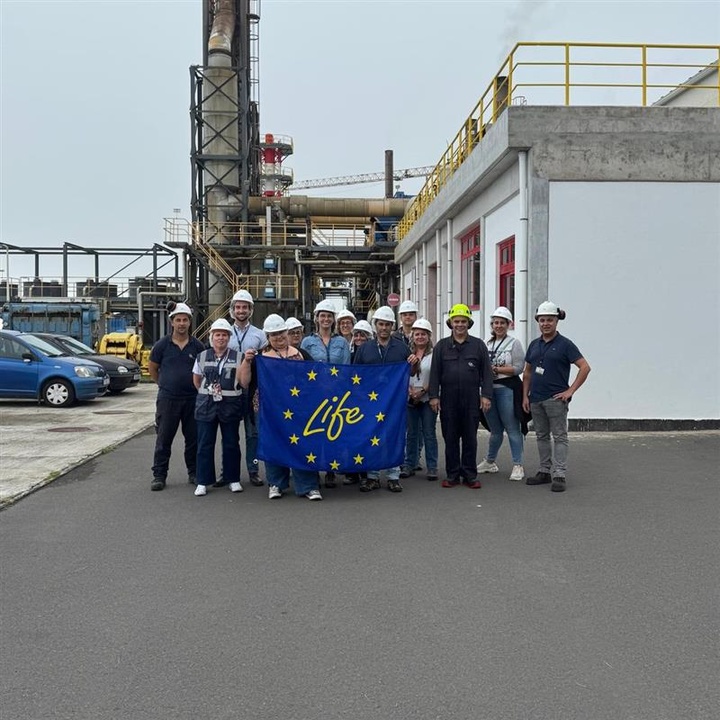
The meeting began with a technical visit to the project’s intervention areas, including the charging points for electric vehicles, Ribeira dos Flamengos and the Santa Bárbara Thermoelectric Power Plant.
On the second day, a formal working meeting was held, both in person and by videoconference, with the participation of all project beneficiaries, namely the Regional Secretariat for the Environment and Climate Action (SRAAC), the Regional Directorate for the Environment and Climate Action (DRAAC), the Regional Directorate for Forest Resources and Spatial Planning (DRRFOT), the Regional Directorate for Maritime Policy (DRPM), the Regional Directorate for Energy (DREn), Eletricidade dos Açores (EDA), Cooperativa União Agrícola (CUA), the Municipality of Vila Franca do Campo (CMVFC) and the Municipality of Horta (CMH).
Throughout the session, the various beneficiaries presented the progress made in implementing the actions and interventions carried out to date. The Regional Secretariat for the Environment and Climate Action announced the acquisition of nine electric pick-up trucks for nature conservation officers. The Project Manager reported that the vehicles are scheduled for delivery between December 2025 and January 2026, reinforcing the Region’s commitment to decarbonising the public land fleet. The start of work on the pilot compensation scheme, aimed at reducing grazing in relevant areas, was also discussed.
In the energy sector, the Regional Energy Directorate has completed the installation of more than 200 electric water heaters on the island of Graciosa, and it is now developing a second campaign that will also cover the island of Flores. In this context, the e-FLEXI project, developed in partnership with EDA, was presented. It consists of an intelligent management system for the consumption of this equipment, based on consumption habits and renewable energy production forecasts.
In addition to its collaboration with DREn, EDA detailed the progress of several projects focused on energy transition in the Archipelago until 2028. Among the main areas of action are the modernisation of the electricity system regulation, the introduction of alternative fuels and the study of large-scale energy storage solutions, with a view to maximising the use of renewable sources.
In its assessment, the Regional Directorate for Forest Resources and Spatial Planning highlighted the use of LiDAR technology, noting that in 2024, the nine islands were flown over to collect data for monitoring soil carbon sequestration. The effort made in converting pastures was also highlighted, with around 5.4 ha already converted on São Miguel and 4.6 ha on Terceira.
The Agricultural Union Cooperative (CUA) confirmed the operational status of the weather stations and moved forward with trials of biodiverse pastures that are more resilient to climate change, as well as the experimental use of Asparagopsis taxiformis seaweed in cattle feed. At the same time, the Vila Franca do Campo Municipal Council has completed construction of a water reservoir, installed the 12 planned drinking troughs, and is currently installing meters to monitor consumption.
Finally, the Horta Municipal Council secured the purchase of a mini electric bus with 29 seats and accessibility for people with reduced mobility, representing a significant milestone for sustainable mobility in the Region.
With financial support from the European Union’s LIFE Programme.